
The Best Headlamp: My Big Comparison for Hiking, Running and the Outdoors
A good headlamp is essential kit on any outing. In my comparison of models under €100, I explain which lights truly deliver—and why the Black Diamond Spot 400 is currently my best all-rounder.

Anyone who spends time outdoors regularly knows the problem: even with good planning, sooner or later you end up out after dark. On a hike, the route takes longer than expected; on a trail run, you start early or get back late; and in autumn and winter, a normal finish to the workday is enough to suddenly find yourself outside in the dark. At moments like these, a good headlamp stops being a nice extra and becomes one of the most important pieces of kit you can have.
When the trail is little more than a faint outline, your headlamp determines whether you can keep moving comfortably or have to start improvising. A good lamp provides more than visibility: it gives you safety, orientation and peace of mind out on the trail. A bad lamp, on the other hand, becomes annoying immediately: it wobbles, fails to shine where it should, dazzles you at the wrong moment, runs out too quickly or, in the worst case, fails completely. That is exactly why it is worth taking a closer look at this topic.
I compared almost ten headlamps priced below €100, including models from Black Diamond, Petzl, Nitecore and NEBO. My aim was not to find the most technically absurd high-end product, but the lamp with the best overall package of real-world usability, reliability, light output, runtime and price. And after many direct comparisons, the result became pretty clear to me.
Why cheap can be a problem—and extremely expensive often is too
There are two common mistakes with headlamps: buying too cheap or being dazzled by the premium segment.
The very cheapest models often look tempting at first glance. Their packaging promises high lumen figures, multiple light colours and all kinds of buzzwords that sound like a lot of performance for little money. In practice, though, the same weaknesses often emerge: poor build quality, unreliable mounts, poorly thought-out controls, unstable tilt adjustment, weak battery performance or questionable durability. With a headlamp, that is not merely annoying—it can also be a safety issue. If a lamp fails on the move, slips out of position or turns itself on and drains its battery, you may literally be left in the dark.
On the other hand, I have also been recommended a headlamp costing around €350. Honestly, for hiking, running and the vast majority of normal outdoor uses, I think that is pretty ridiculous. Expensive lamps cannot override physics, either. LEDs do not have magical rules, battery capacity remains battery capacity, and even in the premium segment you still have to balance weight, runtime, brightness and size. Spending more often gets you specialist features, a brand premium or niche applications—but not automatically real added value for ordinary users.
That is exactly what makes the sub-€100 segment so interesting. You can already find surprisingly mature lamps here, with very good brightness, solid runtime and useful features. In my view, this is clearly the sweet spot.
What really matters in a good headlamp
After the first tests, it quickly became clear to me that marketing figures and the highest lumen rating do not determine whether a headlamp is good. What matters is the interplay of several qualities that you notice directly when you are out using it.
Weight
You do not carry a headlamp in your pocket—you wear it on your head. That is why you notice its weight immediately. What looks like a minor difference on paper can become surprisingly noticeable after several hours. Lamps that are too heavy are distracting when running, feel more sluggish on your head and are simply less comfortable over time. Lamps that are too light, meanwhile, often achieve that with smaller batteries, less stability or functional compromises. Ideally, a lamp stays light without sacrificing everyday usability.
Runtime
Runtime is not a side issue; it is a matter of safety. The brightest lamp is useless if it fades too early in the middle of a trip or delivers good figures only on paper. What matters is not just an impressive maximum figure, but realistic, usable runtime at the brightness levels you actually use. Lamps with replaceable batteries or dual-fuel concepts are particularly strong here, because they minimise downtime and offer far more flexibility on longer trips.
Brightness
Of course, a headlamp needs to be bright enough. But more is not automatically better. At close range, too much light can even be uncomfortable, and excessive contrast in your immediate field of view can hinder rather than help. What matters is therefore not only maximum brightness, but how usefully the lamp makes its output available. Good lamps provide enough reserve for difficult situations without relying solely on crude extremes in everyday use.
Dimming
This point is often underestimated. Many lamps only have fixed brightness levels. In practice, that often means one setting is too bright and the next is already too dark. Stepless dimming is therefore a real comfort feature. It allows finer adjustment for the trail, weather, pace and battery level, making the lamp much more pleasant to use day to day. For me, this is one of the features that shows whether a lamp has really been properly thought through.
Lighting options
A good headlamp should do more than throw a bright spot straight ahead. A focused beam matters for range and orientation at a distance. A broad floodlight helps at close range, such as when walking, reading a map, cooking or setting up camp. Red light is useful too, because it preserves night vision better and is less dazzling to others. A lamp becomes truly strong when these lighting options are not merely present, but integrated sensibly and ideally dimmable.
Tilt adjustment
It sounds basic, but in practice it is extremely important. A lamp needs to shine steadily where you need it. If the lamp head constantly shifts while moving or only has coarse click-stop positions, it becomes annoying immediately. Good tilt adjustment should be firm enough not to slip, yet fine enough to aim the beam precisely.
Ultimately, a good headlamp is always a complete package. Weight, runtime, brightness, lighting options, controls and adjustability all need to work together. That combination is what separates genuinely good models from those that only look interesting on paper.
My test field
I compared several well-known headlamps priced below €100. They included models from Black Diamond, Petzl, Nitecore and NEBO. Some candidates looked very strong on paper, others surprised me with clever details, while others failed on precisely the small points that ultimately matter in real-world use.
It became apparent early on that some manufacturers simply have a better grasp of the fundamentals than others. Black Diamond in particular moved conspicuously far ahead in my comparison because it gets many important things right at once: beam pattern, runtime, flexibility, controls and overall real-world feel. But the other models also had their place—depending on the intended use, with very different strengths and weaknesses.
Comparison table
| Model | Weight | Power source | Lighting options | Key strengths | Weaknesses | My verdict |
|---|---|---|---|---|---|---|
| Black Diamond Spot 400 | approx. 78 g | AAA or BD1500 battery | Spot, flood, red | Dual-fuel, freely dimmable light modes, very strong overall package | Touch button for maximum brightness is annoying | Test winner |
| Black Diamond Storm 500R | approx. 120 g | Batteries | Spot, flood, red, green, blue | very bright, long-lasting, lots of features | heavy, no dual-fuel, battery cover seems vulnerable | strong, but not my favourite |
| Black Diamond Cosmo 350 | approx. 86 g | Batteries | Spot, flood, red | very balanced, good runtime | no dual-fuel | very good, but overtaken by the Spot 400 |
| Petzl Bindi | approx. 35 g | built-in battery | White, red | extremely light and compact | Micro-USB, limited flexibility, no stepless dimming | great for runners, limited for long trips |
| Nitecore NU25 | approx. 53 g | built-in battery | White, red | light, good runtime, two red-light levels | Micro-USB, no stepless dimming, pointless packaging | good, but not quite at the front |
| NEBO MYCRO | compact, but not especially light | built-in battery | White, red, green | very bright, small, handy | unstable mount, weak runtime, poor control logic | lots of potential, poorly implemented |
Black Diamond Spot 400—my clear test winner
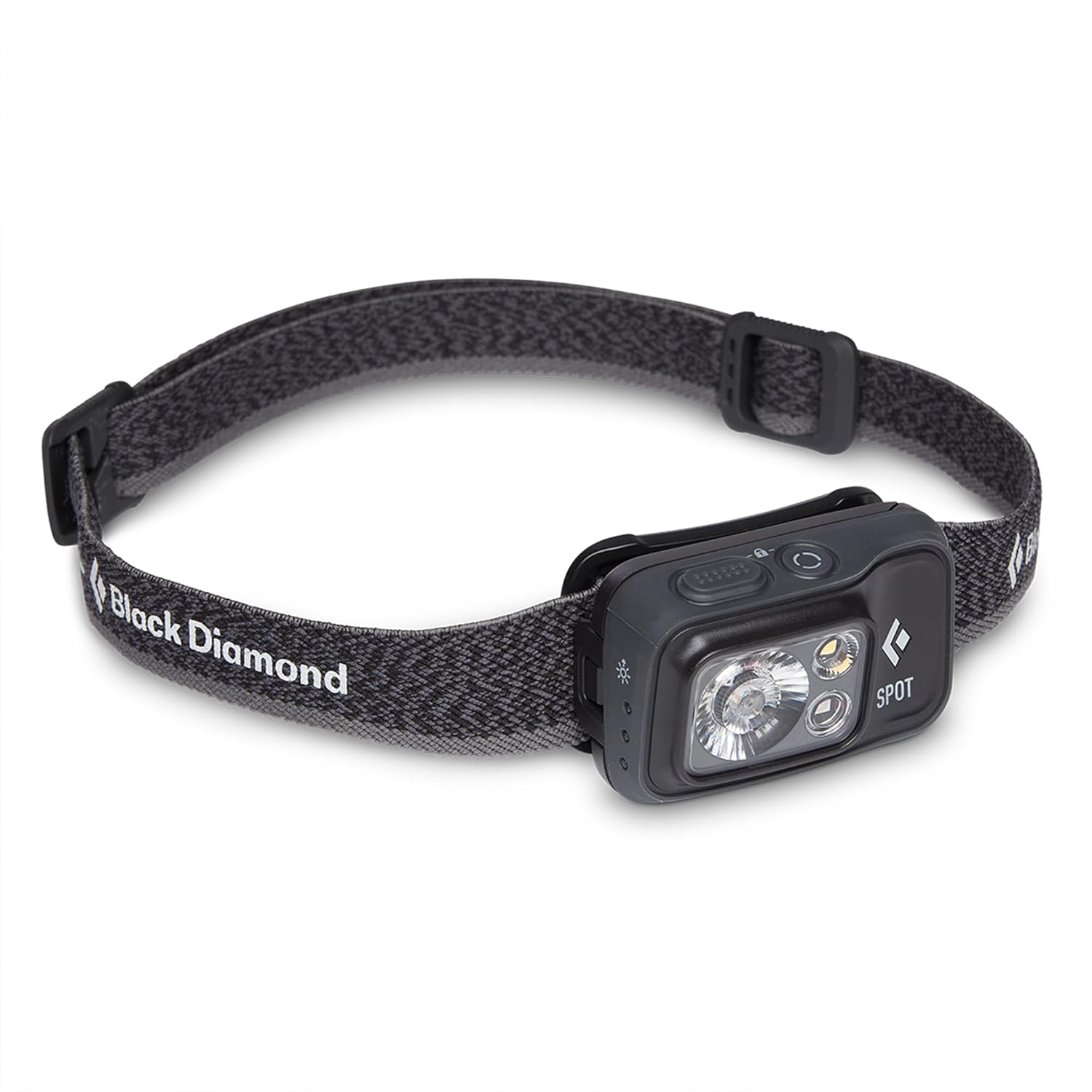
Black Diamond Spot 400
👉 Jetzt ansehen
affiliate linkFor me, the Spot 400 hits the ideal balance between price and performance. I compared almost ten different well-known headlamps below €50, and this model has the best overall package. It sits roughly in the middle of the test field on price, yet can easily compete with more expensive rivals.
What is particularly exciting for me is that, as the direct successor to the Cosmo 350, it has been improved in genuinely useful ways. The Cosmo 350 was previously my favourite, and the 400 actually manages to iron out almost all of its remaining minor weaknesses. The strap has become narrower, brightness and runtime have improved, and the weight has dropped again. For its performance, it is remarkably light and right up there with the best.
The dual-fuel concept is also practical. The lamp can run on either AAA batteries or the BD1500 battery. That is a real plus for me, because it means you are not dependent on a single power source when you are out. Replaceable batteries can mean zero hours of charging time: take the batteries out, put fresh ones in, and keep going. That is a genuine advantage on longer trips.
Functionally, the Spot 400 gets a lot right too. The floodlight is pleasant, the lamp produces a nice beam pattern overall and, above all, the spot, flood and red light are all freely dimmable. None of its rivals solved that as convincingly in my test. It also offers strong runtimes: around 2.5 hours with AAA batteries or 4 hours with the battery at 400 lumens; around 5 or 8 hours respectively at 200 lumens; and up to 200 or 225 hours respectively in low mode at 6 lumens. The tilt adjustment is now stepless and still feels pleasantly firm, without seeming wobbly.
The biggest criticism, as with other Black Diamond models, remains the touch button for maximum brightness. The idea is nice, but in practice I triggered it accidentally several times and ended up dazzling myself. I would most like to be able to disable it.
Even so, my conclusion remains clear: unless you specifically need the Storm’s longer runtime and additional light colours, you should choose the Spot 400. For me, it is the best headlamp under €50.
Spot 400: quick verdict
- Excellent balance of price, performance and features
- Dual-fuel is a genuine advantage in everyday use and on trips
- All relevant lighting modes are freely dimmable
- Light, bright, long-lasting and flexible
- Annoying touch boost is its only real flaw
Black Diamond Storm 500R—bright, long-lasting and feature-packed, but too bulky

Black Diamond Storm 500R
👉 Jetzt ansehen
affiliate linkThe Storm 500R was one of the final candidates in my comparison and also comes from Black Diamond’s strong line-up. It takes many of the Spot series’ strengths and expands on them in several areas. At the same time, however, it clearly shows that more features do not automatically make for a better lamp.
Its price is also in the middle of the field, so it is by no means extravagant. On paper, it holds up well against more expensive models too. The packaging is practical—not as minimalist as Petzl’s, but far more sensible than Nitecore’s or NEBO’s.
In practice, its weight is what stands out most. At around 120 grams, it is by far the heaviest lamp in the test field, and you can feel it. The strap distributes the weight well and keeps the lamp stable, but it is still much more noticeable on your head than its rivals. You have to want that.
On the plus side, it has some genuine strengths: replaceable batteries, pleasant floodlight, freely dimmable light modes, strong brightness and very good runtime. In addition to red light, the Storm also offers green and blue light. I personally have limited use cases for those, but I can imagine them being interesting for specific activities such as fishing. The adjustment feels solid, although it is not stepless.
What bothers me about the Storm, though, are exactly the compromises you make for those extra functions. It is heavier, offers no dual-fuel mode and has a lever on the battery cover that does not inspire much confidence. You can already tell when closing it that this is not the most robust solution. If a closure like that becomes the weak point, it is a real deal-breaker for me, because an otherwise good lamp can quickly become expensive electronic waste.
For me, the Storm 500R is therefore a classic case of “lots done right, but the wrong overall profile”. It is bright, long-lasting and feature-packed, but the extra weight and questionable battery cover mean it is not the best choice for me.
Storm 500R: quick verdict
- Very bright, long-lasting and packed with features
- RGB light may be interesting depending on the use case
- Significantly heavier than the Spot series
- Battery cover seems like a potential weak point
- Not a convincing recommendation for me
Black Diamond Cosmo 350—almost the best in its segment
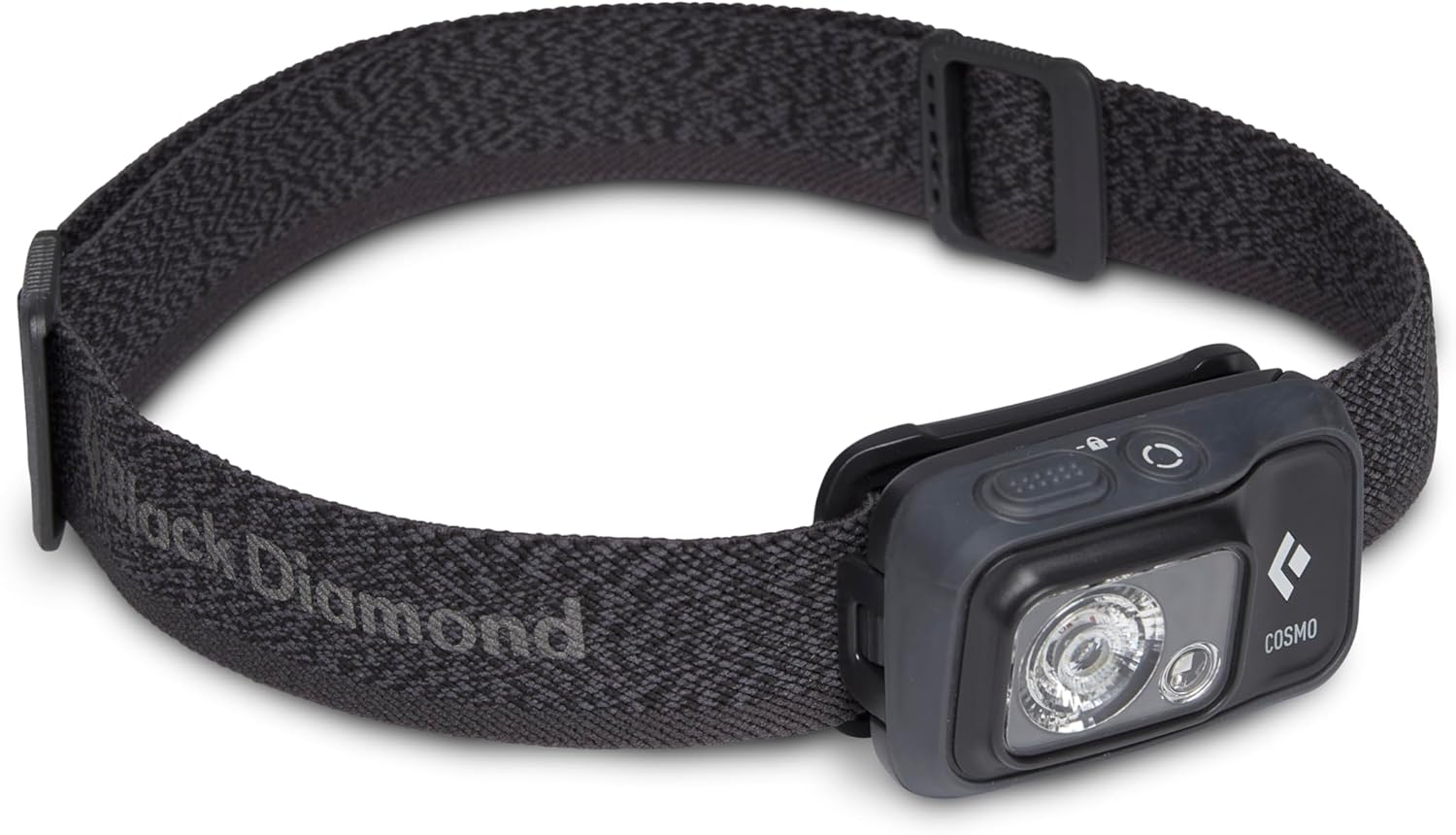
Black Diamond Cosmo 350
👉 Jetzt ansehen
affiliate linkThe Cosmo 350 was my favourite in this price range for a long time, and it is still a very good headlamp today. Anyone looking in the sub-€50 segment will almost inevitably come across this model at some point, and for good reason. Price and performance are already very convincingly matched here.
The Cosmo 350 also sits in the middle of the test field on price and can certainly keep up with many more expensive models. The packaging is sensible, the lamp feels well thought out and, in direct comparison, it was my benchmark for a long time.
At around 86 grams, it is not quite as light as the new Spot 400, but still falls into a very reasonable range. Its major strength lies in the overall package: replaceable batteries, pleasant light, freely dimmable spot, flood and red-light modes, good runtimes and convincing everyday usability overall. Its battery runtimes are impressive too: around 4 hours at 350 lumens, 8 hours at 175 lumens and up to 200 hours at 6 lumens.
Its tilt adjustment is not yet stepless, but it feels nicely firm and durable. Here too, the touch button for maximum brightness remains an unnecessarily annoying point. The Cosmo 350 also lacks the dual-fuel mode that Black Diamond only introduced with the Spot 400.
That is ultimately why the Cosmo 350 finishes just behind its successor for me. It does an enormous amount right and would almost have remained my favourite. But the Spot 400 simply goes one step further and largely eliminates even the Cosmo 350’s minor quirks.
Cosmo 350: quick verdict
- A very well-rounded overall package
- Good runtime, good light, replaceable batteries
- Many things already at a very high level
- No dual-fuel
- Mainly worth considering now if it is significantly cheaper
Petzl Bindi—small, light and bright, but a little inflexible

Petzl Bindi
👉 Jetzt ansehen
affiliate linkThe Petzl Bindi is a special case in this comparison because it has a very different profile from many of the other lamps. It does not try to be the universal all-rounder; instead, it clearly focuses on minimal weight and compact construction. And it does that impressively well.
Unlike Nitecore and NEBO, the packaging is very pleasantly done: no unnecessary plastic, plenty of cardboard and a far more sensible overall approach. At 35 grams, the lamp itself is by far the lightest in the test field, and it is not only light but genuinely small too. That is what sets it apart from other lamps, where users often have to replace the strap first to get the weight down to a sensible level. Petzl has thought this through consistently from the start.
For its weight, the Bindi offers a surprisingly strong package. It is nicely bright, produces pleasant light, has red light and offers good runtime for this weight class. The adjustment is stepless while still firm enough, which is by no means a given. Details like these show that the lamp is well designed overall.
Even so, the Bindi is not a universal recommendation for me. The red light has only one level, which I find rather too dim. There is also Micro-USB instead of USB-C, no stepless dimming and a built-in battery. Its charging time of around four hours is not exactly impressive either. That makes it noticeably less flexible than some rivals for longer trips.
Ultimately, the Bindi is the perfect lamp for me when you want something as small, light and uncomplicated as possible. It is great for runs in the park or short outings. But on longer trails or hikes, its concept reaches natural limits.
Petzl Bindi: quick verdict
- Extremely light and very compact
- Excellent for runners and minimalists
- Strong hardware foundation
- Micro-USB and a built-in battery no longer feel up to date
- Only conditionally ideal for long trips
Nitecore NU25—bright, long-lasting and light, but not consistent enough
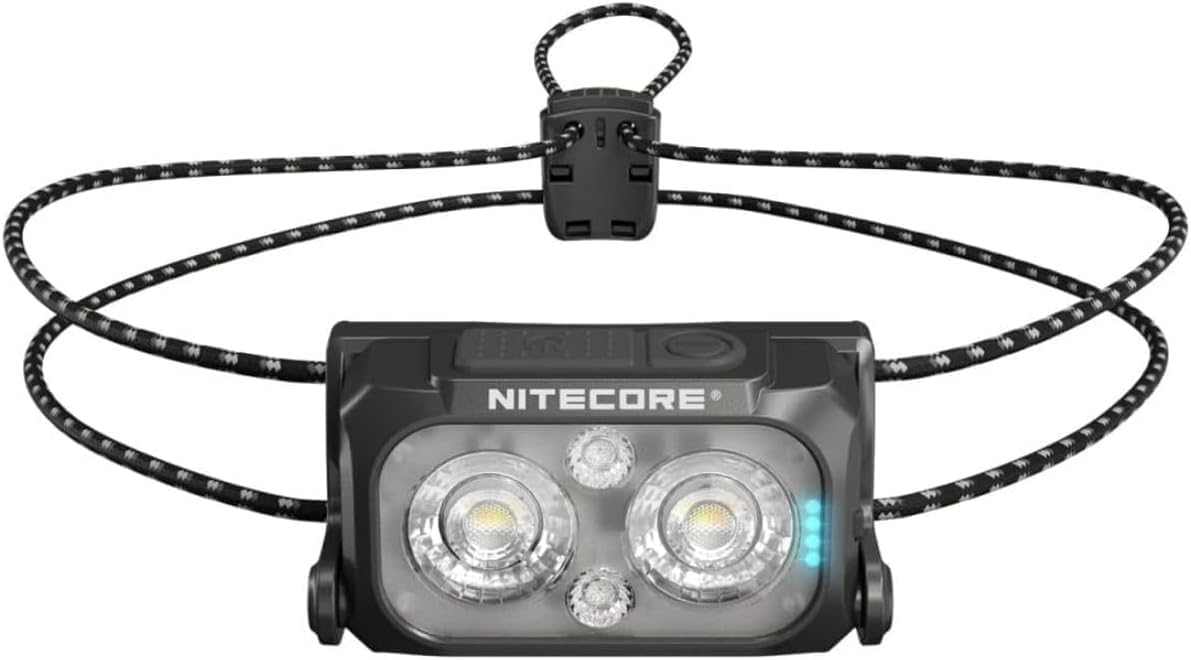
Nitecore NU25
👉 Jetzt ansehen
affiliate linkThe Nitecore NU25 is a lamp that gets a lot right at first impression. It is light, bright, offers red light at two brightness levels and has genuinely decent runtime for its weight. On paper, that initially sounds like a very strong candidate.
Unfortunately, the first disappointment starts with the packaging. As with NEBO, it is unnecessarily impractical: glued cardboard layers, sealed plastic sleeves and an overall experience that is more frustrating than premium. This is not a core criterion for lamp performance, of course, but it does not exactly convey a particularly well-thought-out overall impression.
In use, the NU25 has some real advantages. The light colour is pleasant, its weight of around 53 grams is pleasingly low, and the two red-light levels in particular are practical. Its runtimes are decent for such low weight too. Still, in direct comparison, I always felt that other manufacturers do a few things a little more smoothly.
To me, the lamp is slightly too large for what it delivers. In my view, Black Diamond shows that the volume can be used more efficiently. Then there is Micro-USB, a non-replaceable battery and the lack of stepless dimming. These are exactly the points that stop an otherwise good lamp from competing right at the front.
That does not make the NU25 bad. On the contrary: it gets many things right. But around the €40 mark, there are rivals that offer the better overall package for me. That is why it did not end up among my favourites.
Nitecore NU25: quick verdict
- Light, decent runtime, practical red-light levels
- Pleasant light colour
- Micro-USB and a built-in battery are clear weaknesses
- No stepless dimming
- A good lamp, but not my first choice
NEBO MYCRO—affordable, bright, unstable

Nebo Mycro
👉 Jetzt ansehen
affiliate linkThe NEBO MYCRO is the kind of candidate where, after trying it for the first time, you think: there is actually a lot of potential here. It is small, handy, visually quite appealing and impressively bright at first glance. In boost mode, it delivers up to 400 lumens, and the light feels pleasantly neutral in a wide beam. It also has red and green light, which is far from a given in this price range.
Unfortunately, in practice it quickly reveals several weaknesses that hit exactly where it matters. The control logic is unfortunate: when switching brightness levels, it starts out bright, so you may be dazzled first before reaching a more comfortable level. There is no key lock, so accidentally switching it on in your pocket is a real risk. And for its small size, it is not as light as you might expect.
My biggest criticism, however, is the mechanism. The mount does not inspire much confidence and, above all, the tilt adjustment is far too loose. With more vigorous movement, the lamp shifts by itself. That effectively rules it out for active use. A headlamp that constantly drops down while walking or running is ultimately not very useful.
Its battery performance is also disappointing for the weight. One hour at 150 lumens is simply too little in this comparison. Taken together, it remains a lamp that hints at a lot of potential but has been implemented too inconsistently in several crucial areas.
NEBO MYCRO: quick verdict
- Very bright, with pleasantly neutral light
- Compact and with additional light colours
- Weak mechanism and poor adjustment
- Controls and runtime disappoint
- Not recommended for active use, in my view
My conclusion: the best headlamp under €100
After this comparison, the outcome is pretty clear to me. Most lamps do not fail because of too little performance on paper, but because of the small things that constantly stand out in practice: a poor mount, no dimming, outdated charging ports, unnecessary weight or an inflexible power concept.
That is precisely why the Black Diamond Spot 400 stands out so clearly. It is not only bright enough, long-lasting enough and comfortable enough to wear—it is above all the lamp with the most coherent combination of qualities. It combines good runtimes with low weight, offers pleasant light, stepless dimming across all important lighting modes and, with dual-fuel, a genuine real-world advantage that many competitors simply do not have.
The Cosmo 350 remains a very good lamp and was my favourite for a long time for good reason. The Storm 500R is powerful, but too heavy for me and not mechanically convincing enough. The Petzl Bindi is excellent for runners and minimalists, but not universal. The Nitecore NU25 is good, but falls behind the competition in important details. And the NEBO MYCRO shows that a few good ideas do not yet make a good headlamp.
If I had to make one single recommendation in the sub-€100 segment today, it would clearly be:
My recommendation: Black Diamond Spot 400
For me, it is the best all-rounder for hiking, running and general outdoor use—and exactly the lamp where price and performance come together most successfully.
Disclaimer
Some links are affiliate links. They support my work at no extra cost to you.


Join the conversation
Become a member of One More Step to leave a comment.