
Four Weeks to the Summit: Training, Progress and What Matters Now
Four weeks before Kilimanjaro, I take stock: how my training has changed, why stairs, incline and long-distance walks matter, and why preparation offers no summit guarantee—but a realistic chance.

Less than a month until the start.
By now, that sentence feels pretty real. What sounded like a big, distant goal months ago is getting closer every day. Kilimanjaro is no longer just another project on a list, but a fixed date in the calendar. And with that comes the phase when “I’m preparing” slowly turns into “Am I really ready?”
The short answer: I’m much further along than I ever expected at the beginning.
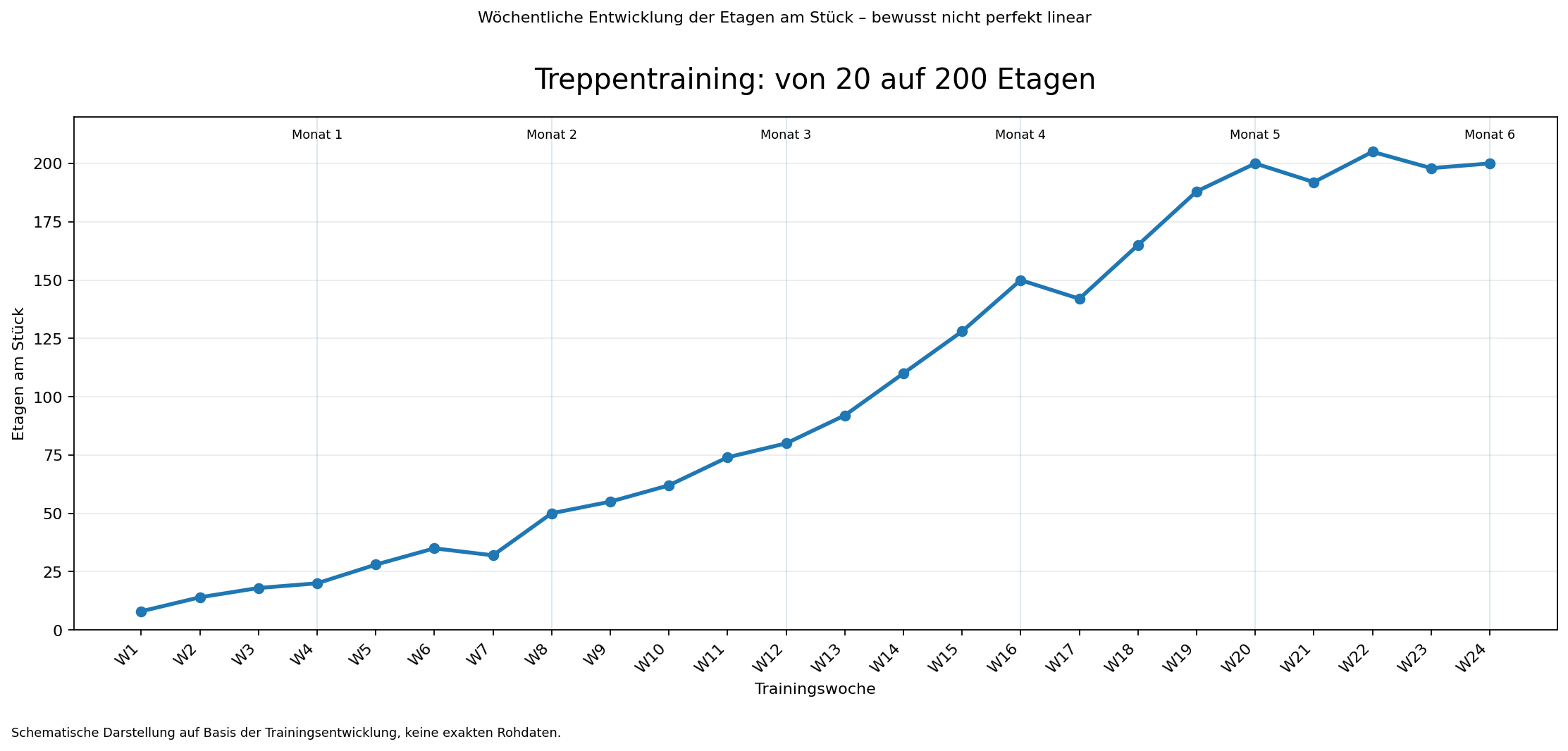
When I started preparing, stair training was still pretty sobering. After 20 flights, I was properly done in. Heavy legs, laboured breathing, and my mind somewhere between “It’ll be fine” and “How is this supposed to work on a mountain?”
Now things look different. Climbing 200 flights of stairs in one go is no longer a problem. Not easy, not something I do on the side, but doable. And for me, that is one of the biggest improvements of the past few months: it’s not just individual training numbers that have improved, but my whole sense of exertion has changed. What used to feel like my limit is now a training stimulus.
The final phase of preparation
The past few months have been defined by plenty of LES MILLS BODYPUMP, treadmill sessions at an 18 percent incline, cycling and stair training. The focus was quite clearly on three things:
- Leg strength
- Endurance
- Controlled exertion over longer periods
The treadmill at an 18 percent incline in particular has been a valuable part of my training. Of course, it doesn’t simulate a real mountain, altitude, terrain or a long trekking day with a backpack. But it puts the body under precisely the kind of sustained uphill effort that is crucial for Kilimanjaro.
Stair training has also proven extremely effective. It is simple, brutally honest and hard to sugar-coat. Every flight counts. Every repetition shows you pretty directly where you stand.
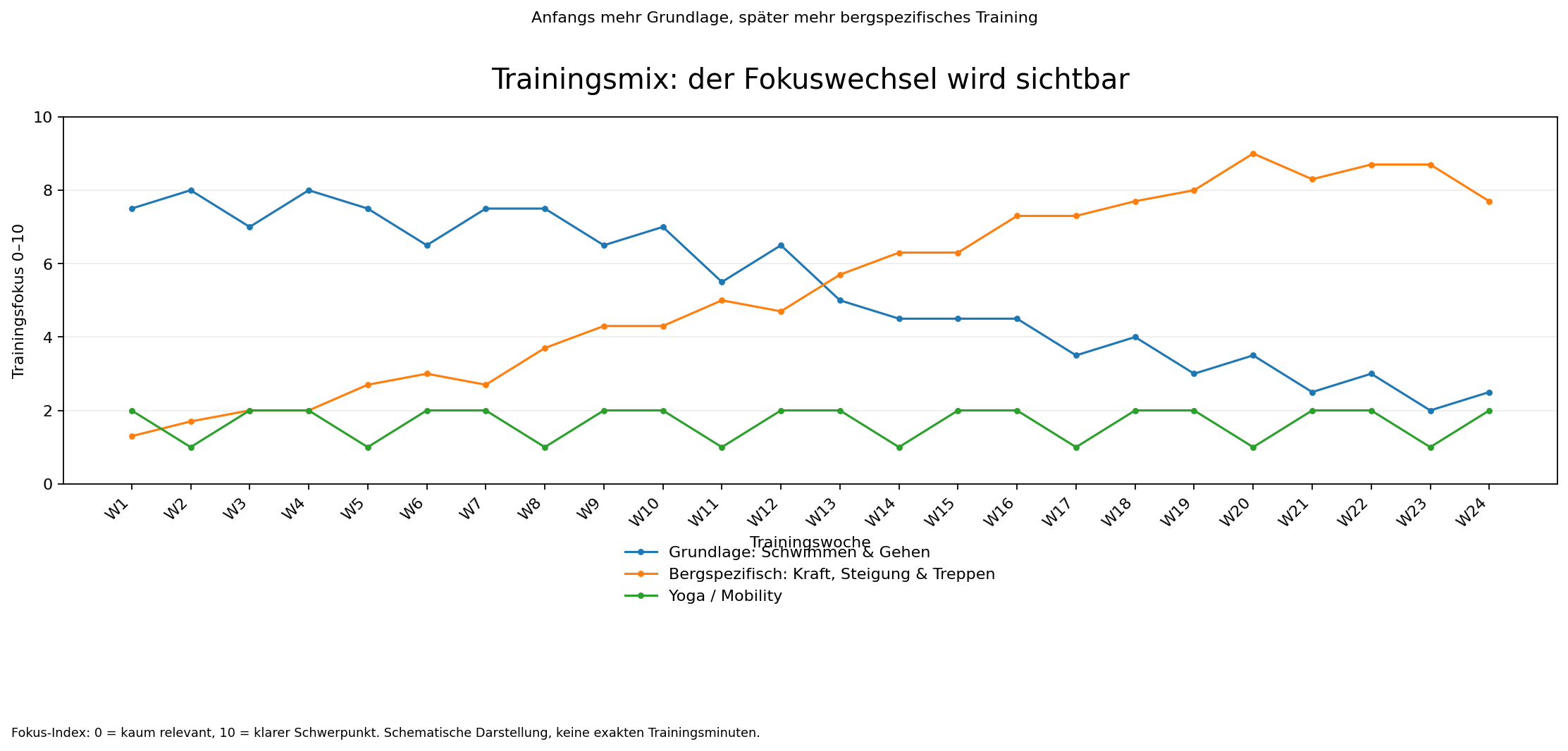
I also took on my first Mammut Marches and ultra marches between 30 and 80 kilometres. That was important to me because distances like these test things that are easy to underestimate in regular fitness training: mental endurance, the strain on your feet, energy management and how the body responds after being on the move for many hours.
The real-world endurance tests
Alongside training in the gym, on the treadmill, on the bike and in the stairwell, there have also been a few real endurance tests outdoors since I began planning.
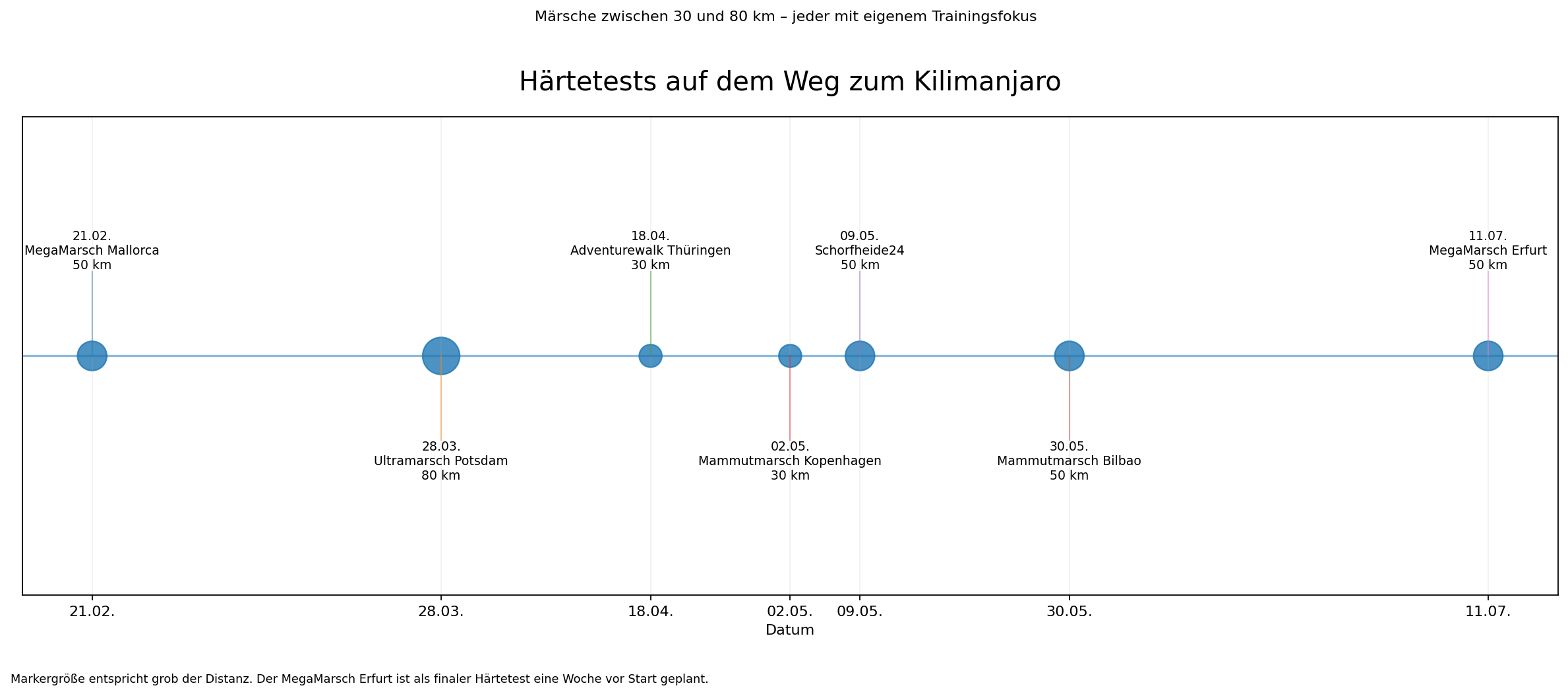
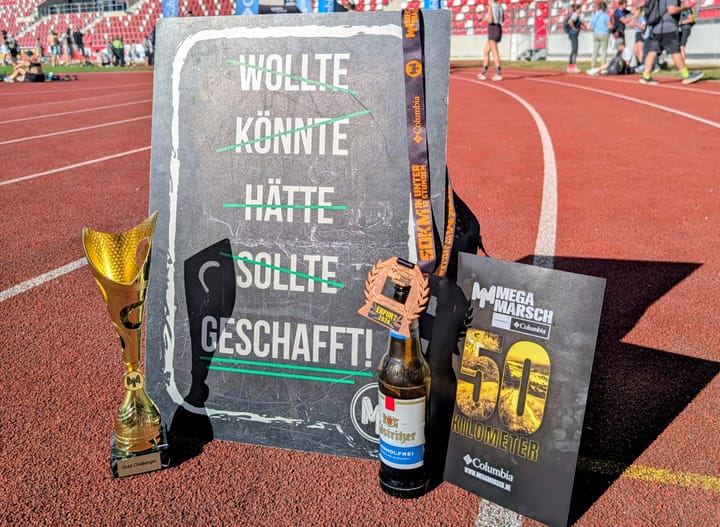
On 21 February, I took on the 50-kilometre MegaMarsch Mallorca. At the time, the main focus was getting moving again, spending a long time on my feet and collecting elevation gain.
That was followed on 28 March by the 80-kilometre Ultramarsch Potsdam. It was less mountain training and more a very good test of endurance and mental resilience. At some point, distances like these stop being just about your legs; they are also about staying calm, keeping going and getting through difficult phases.
On 18 April, I added the 30-kilometre Adventurewalk Thüringen—with a clear focus on mountains. In early May came the 30-kilometre Mammutmarsch Copenhagen, which was mainly about staying on track and maintaining consistency.
With the 50-kilometre Schorfheide24 on 9 May, the focus shifted back more towards endurance. At the end of May, the 50-kilometre Mammutmarsch Bilbao brought heat and mountains together. That was especially important for me because heat, climbs and prolonged exertion come much closer to at least some of the factors that may play a role on Kilimanjaro.
One week before departure, I’ll finish with the 50-kilometre MegaMarsch Erfurt. The focus there: mountains and temperature—a final endurance test before I deliberately ease off.
The pulmonologist and 135 percent
Halfway through my preparation, I also visited a pulmonologist. With a mountain like Kilimanjaro in mind, I wanted to know where my lungs currently stood.
The result was hugely motivating for me: 135 percent lung function, along with plenty of encouraging words and support for my project.
Of course, that does not mean that nothing can happen automatically at almost 6,000 metres. Altitude is a factor in its own right. Acclimatisation, how you feel on the day, sleep, weather, cold and your pace on the mountain all play a major role.
But it is a good sign. And above all, for me, confirmation that the training is moving in the right direction. More air, more capacity, more trust in my own body.
One uncertainty remains: my heart rate
One thing that still concerns me despite all the progress is my heart rate.
My heart rate has always tended to run high under exertion. During stair training, I quickly reach 160 bpm. When cycling, I also soon end up in ranges that others might not reach until much later. Training has improved this, but it hasn’t suddenly disappeared.
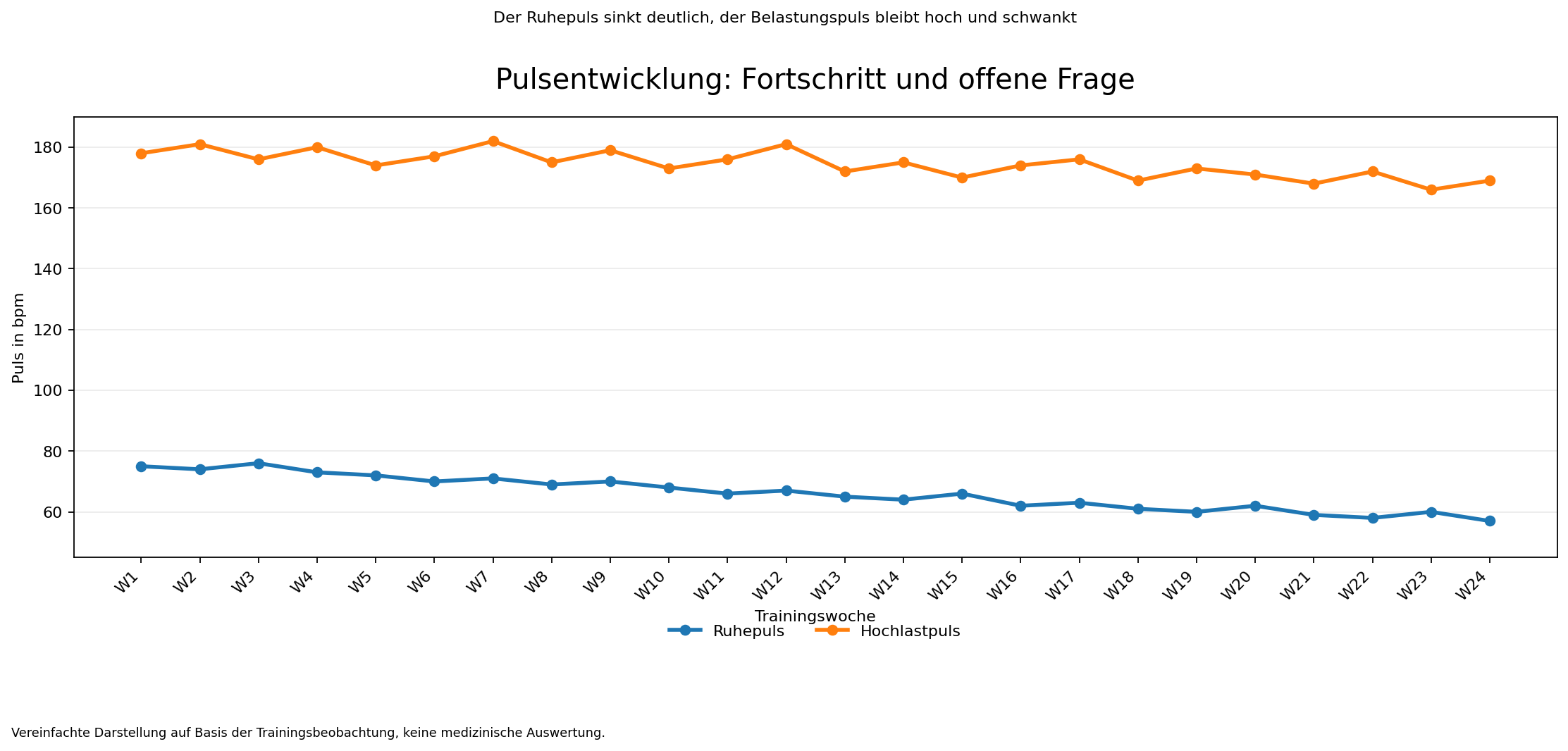
And of course, I wonder: will that be a problem on the mountain?
I hope not. At the same time, I don’t want to sugar-coat it. Kilimanjaro is not a place where you simply push stubbornly against your own body. Especially at altitude, it will be crucial to go slowly, not overdo it and watch for warning signs early.
For me, that means my heart rate is one signal, but not the only measure. What matters will be how I feel. Am I still breathing well? Can I recover? Do I have headaches, dizziness, nausea or unusual exhaustion? Does the effort remain manageable?
On the mountain, it won’t be about moving at any kind of athletic pace. It will be about travelling as efficiently and calmly as possible. Pole pole, as they say on Kilimanjaro: slowly, step by step.
Maybe that is the most important lesson of all this preparation. I have become stronger, but the mountain will not be decided by strength. It will be decided by patience, body awareness and the willingness to slow down in time.
No guarantee, but a realistic chance
That puts me pretty much exactly in the target range I set for my preparation.
That does not mean the summit is certain. Kilimanjaro remains a high mountain. There is no guarantee that everything will work out. You can be well trained and still have problems with altitude. You can be motivated and still have a bad day.
But preparation changes your starting point.
I don’t assume that I will “conquer” the mountain. I don’t particularly like that word anyway. The mountain remains the mountain. All I can do is arrive as well prepared as possible, listen to my body and give myself a realistic chance of reaching the summit.
That is exactly where I feel I am right now.
What I tested and dropped: EMS
One thing I tried as part of my preparation was EMS training—electrical muscle stimulation, where additional impulses are applied to the muscles during training.
I tested it, but stopped again relatively quickly.
Not because EMS is fundamentally bad. I do think it can strengthen the muscles throughout the body. It may make sense for other goals. But for my Kilimanjaro focus, it wasn’t the right priority.
For me, Kilimanjaro is not about building as much muscle mass as possible. It is about endurance, efficient movement, leg strength, breathing and the ability to keep going for a long time. More muscle is not automatically an advantage if it is not needed functionally. Muscles need to be supplied; they consume oxygen—and at almost 6,000 metres, oxygen is exactly what becomes scarcer.
That is why I ruled out EMS for myself. Not as a general judgement, but as a decision for this specific goal.
What I have taken away from my preparation so far
If I had to draw a few recommendations from the past few months, they would be these:
1. Don’t just train fitness—train for the specific challenge
For Kilimanjaro, general fitness is not enough. Of course, being sporty helps. But the mountain places very specific demands on you: walking for many hours, often slowly uphill, with less oxygen, in changing temperatures and over several days.
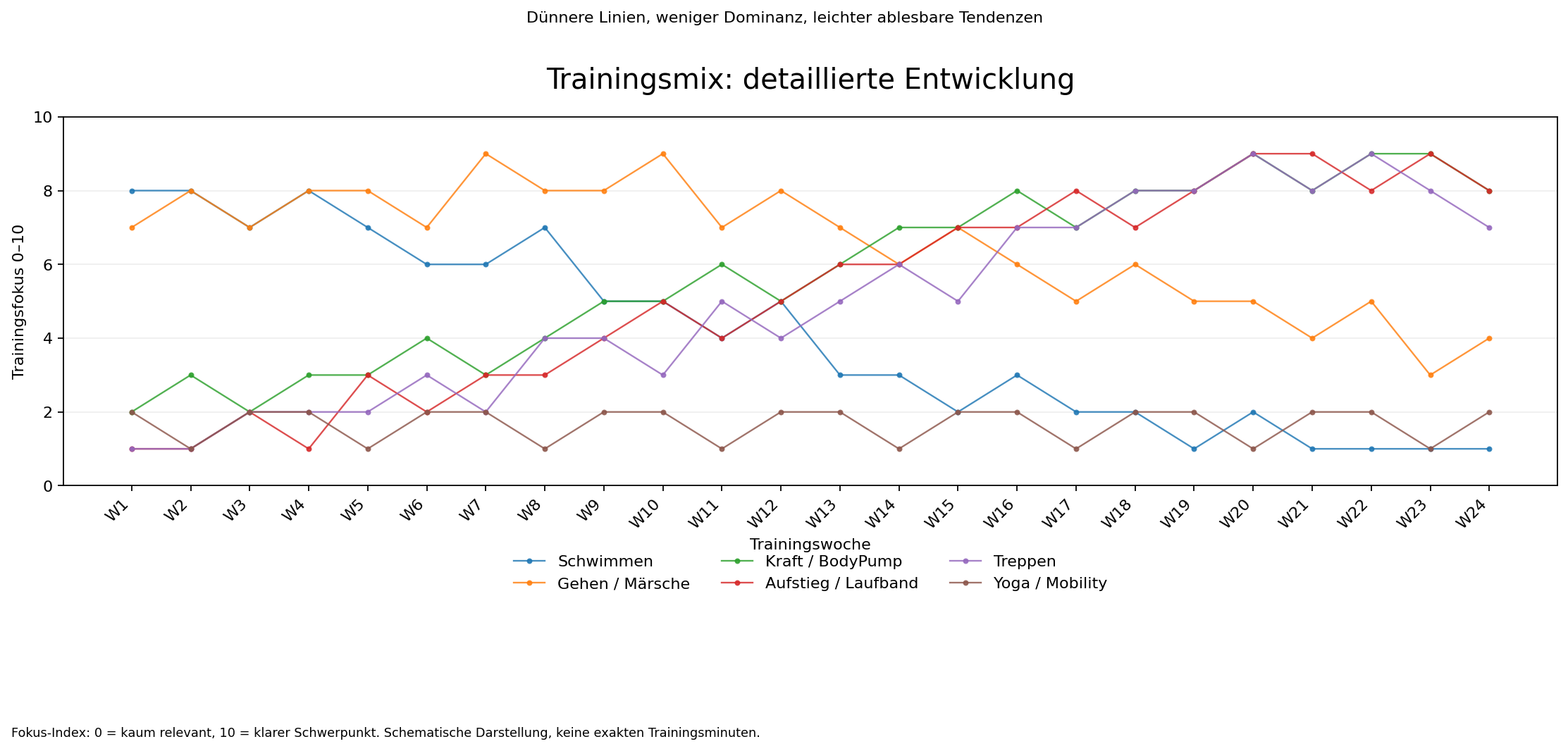
That is why training should come as close as possible to those demands. For me, that meant incline, stairs, long-distance walks, controlled endurance and, again and again, legs, legs, legs.
It should also follow exactly this cycle:
- Build a foundation
- Shift more and more towards the demands of the mountain
- Never completely lose sight of the basics
I continuously adapted and planned my training activities around this.
2. Stairs are underestimated
Stairs are not glamorous. They do not look spectacular on Instagram. But they work.
Anyone who regularly climbs lots of flights quickly notices progress. Your legs become more stable, your breathing calmer and your mind gets used to enduring monotonous uphill effort. That can be hugely valuable on a mountain.
3. Long-distance walks test more than fitness
A 30-, 50- or 80-kilometre walk is not classic mountain training. But it shows very clearly how the body responds over many hours.
Where do blisters form? How does eating on the move work? How much do I need to drink? What happens mentally after six, eight or ten hours? Which clothes become annoying after a while? Which shoes really work?
You do not get these experiences from spreadsheets. You have to walk them.
4. Strength training, yes—but functional
BODYPUMP and strength training have helped me become more stable. My legs, core and overall resilience especially benefit from it. But for my goal, it is not about maximum strength or maximum muscle mass.
I don’t want to look strong on the mountain. I want to be able to walk as efficiently as possible.
5. A medical check provides reassurance
The appointment with the pulmonologist was important to me. Not because it guarantees the summit, but because it provides a better foundation. Especially if you have a history of issues such as exercise-induced asthma, breathing problems or uncertainty under high exertion, a check like this makes sense.
In the end, you take away more than just numbers—you also gain a little peace of mind.
The final weeks: don’t overdo it
Now begins the phase when I need to be especially careful.
The temptation is great to do even more in the final weeks. More flights, more incline, more long sessions. But at some point, training no longer gets better—it just becomes more.
That is why the focus over the coming weeks will remain on leg strength, endurance and climbs—but with a sense of proportion. For me, it will end with the MegaMarsch in Erfurt, one week before departure. After that, I will deliberately take a rest phase so that I set off for Tanzania not exhausted, but ready.
Because this, too, is part of preparation: stopping the urge to become stronger at the right time and giving your body the chance to truly use the work of the past few months.
Conclusion: ready does not mean certain
Four weeks before Kilimanjaro, I feel well prepared.
Not overconfident. Not certain. But realistically optimistic.
I have significantly improved my performance. I have tested myself over long periods of exertion. I have had my lungs checked. I know better what my body can do, where my limits are and what I need to pay attention to.
The summit remains uncertain. That is part of it.
But I am not setting off unprepared. And right now, that is the most important thing for me.

Join the conversation
Become a member of One More Step to leave a comment.